
This article is for Canadian and American retirees (ages 55–70) who are seriously considering a permanent or part-time move to Mexico. It covers the visa process, cost of living, healthcare, pensions, taxes, and the top cities — with specific notes for Canadians throughout.
Key Takeaways
- To qualify for a Mexican Temporary Resident visa, you need to show approximately $4,200 USD/month in income or $70,000 USD in savings (2026 figures).
- A comfortable retirement in Mexico costs most couples between $1,800 and $3,000 USD per month, depending on the city.
- Your Canadian provincial health plan (OHIP, MSP, etc.) does not cover you in Mexico. Healthcare planning is essential before you move.
- Your CPP, OAS, and Social Security benefits are fully portable to Mexico, though a 15% Canadian withholding tax applies to pension income.
- Lake Chapala, Puerto Vallarta, and Mérida are the most established destinations for Canadian and American retirees.
Mexico is not just a winter escape anymore. For a growing number of Canadians and Americans, it has become a permanent home — one where the cost of living is a fraction of what it is back north, the climate is generous, and the culture rewards those who show up with curiosity and an open heart. My wife, Yvonne, is Mexican, and over the years of planning our own part-time life between Vancouver and Mexico, I have come to understand both the genuine appeal and the real-world complexity of making this move. This guide is the honest, practical resource I wish had existed when we started.
What follows is not a sales pitch for Mexico. It is a clear-eyed look at what it actually takes to retire there legally, affordably, and well — with specific attention to the issues that trip up Canadians most often.
Is Retiring in Mexico Right for You?
This guide is for people who are ready to do the work. Retiring in Mexico is not complicated, but it does require patience, documentation, and a willingness to navigate bureaucracy in a second language. The rewards — lower costs, warmer weather, a vibrant culture, and a pace of life that is genuinely restorative — are real. But so are the challenges: adjusting to a new healthcare system, managing cross-border finances, and building a new social life from scratch.
If you are looking for a carbon copy of your life in Canada or the United States, Mexico will frustrate you. If you are open to a different way of living, it will surprise you in the best possible way.
The #1 Hurdle: Proving Financial Solvency for Your Visa
Before you can legally live in Mexico long-term, you must prove to the Mexican government that you can support yourself financially. This is the central requirement of the residency application process, and it is where most applicants either succeed or stumble.
Temporary vs. Permanent Residency
Most retirees begin with a Temporary Resident visa (Residente Temporal). This visa is initially issued for one year and can be renewed for up to three additional years, for a maximum of four years total. After four consecutive years as a temporary resident, you become eligible to apply for Permanent Residency (Residente Permanente), which does not expire and requires no further renewals. Many retirees deliberately use the temporary residency period as a “test drive” — a chance to confirm that their chosen city and lifestyle are the right fit before committing permanently. For a deeper look at the full residency process, see our Mexico Residency Guide.
2026 Income and Savings Requirements
The financial thresholds are calculated using Mexico’s official reference unit, the UMA (Unidad de Medida y Actualización), which is updated annually. The 2026 UMA value is $117.31 MXN per day. Requirements can vary slightly between consulates, so always verify with the specific office where you plan to apply.
| Residency Type | Monthly Income Required | Savings/Investment Balance Required |
|---|---|---|
| Temporary Resident | ~$79,771 MXN (~$4,200 USD) | ~$1,344,373 MXN (~$70,000 USD) |
| Permanent Resident | ~$133,733 MXN (~$7,100 USD) | ~$5,378,664 MXN (~$280,000 USD) |
For Canadians: Your CPP, OAS, and RRIF distributions all count toward the income requirement. Bring official letters from Service Canada confirming your CPP and OAS amounts, plus statements from your financial institution for any registered accounts.
For Americans: Social Security benefits and distributions from 401(k) or IRA accounts are accepted. An official Social Security benefits letter from the SSA, combined with investment account statements, is typically sufficient.
Your Monthly Budget: What a Comfortable Retirement in
Most couples report living comfortably — with a housekeeper, a car, dining out regularly, and taking occasional trips — for between $1,800 and $2,500 USD per month. The table below provides a realistic monthly budget for a retired couple. For a more detailed city-by-city breakdown, see our full Cost of Living in Mexico guide.
| Expense Category | Budget Range (USD/month) |
|---|---|
| Housing (2-bedroom rental) | $600 – $1,200 |
| Utilities (electricity, water, gas, internet) | $100 – $250 |
| Groceries (mix of local markets and supermarkets) | $350 – $550 |
| Healthcare (private insurance or IMSS) | $150 – $400 |
| Transportation (local transit, rideshares, occasional taxi) | $50 – $150 |
| Dining out and entertainment | $200 – $400 |
| Housekeeper (2–3 days/week) | $80 – $150 |
| Total Estimated Monthly Cost | $1,530 – $3,100 |
City-by-City Cost Comparison
| City | Typical 2BR Rental (USD/month) | Climate | Expat Community Size |
|---|---|---|---|
| Lake Chapala / Ajijic | $600 – $1,200 | Temperate, no AC needed | Very large (world’s largest expat concentration) |
| Puerto Vallarta | $1,200 – $1,800 | Hot and humid; AC essential | Large; bilingual services widely available |
| Mérida | $700 – $1,000 | Very hot summers; AC essential | Growing rapidly; excellent safety record |
| Mazatlán | $800 – $1,300 | Warm; moderate humidity | Mid-size; more affordable than PV |
| San Miguel de Allende | $900 – $1,500 | High altitude; mild year-round | Large; strong arts and culture scene |
Healthcare in Mexico: Your Three Main Options
Healthcare is the concern I hear most often from Canadians considering a move to Mexico, and it deserves a frank and thorough answer. The bottom line is this: Mexico has excellent healthcare, but you must plan for it proactively, because your home country’s public system will not be there to catch you. Our dedicated Healthcare in Mexico page covers private clinics, insurance providers, and what to expect in detail.
Option 1: Voluntary Enrollment in IMSS (Mexicos Public
Mexico’s public healthcare system, the Instituto Mexicano del Seguro Social (IMSS), is available to legal residents on a voluntary basis. A person in their 60s currently pays approximately $18,300 MXN (roughly $900 USD) per year; a couple in their 60s would pay around $37,000 MXN (roughly $1,800 USD) per year. IMSS coverage is comprehensive for what it includes — hospital care, specialist referrals, and prescription medications at no additional cost — but all services are provided in Spanish only, and certain pre-existing conditions are excluded from coverage entirely.
Option 2: Private Health Insurance
The majority of expat retirees carry private health insurance. A comprehensive private policy gives you access to private hospitals, shorter wait times, and English-speaking physicians. Costs vary by age, health status, and coverage level, but private insurance in Mexico is substantially more affordable than comparable plans in the US or Canada.
Option 3: Paying Out-of-Pocket for Routine Care
For routine visits, dental work, eye care, and minor procedures, paying out-of-pocket at private clinics is often the most practical and affordable option. A visit to a private general practitioner in Mexico typically costs $400–$600 MXN (about $20–$30 USD).
A critical note for Canadians: Your provincial health insurance plan — whether OHIP, MSP, AHCIP, or any other — provides little to no coverage outside of Canada. Do not move to Mexico without a healthcare plan in place.
Taxes, Pensions, and Cross-Border Finances
For Canadians: The 15% Withholding Tax
Under the Canada-Mexico Income Tax Convention, your CPP, OAS, and registered pension plan (RPP) payments are subject to a 15% withholding tax at the source. This means the Canadian government will deduct 15% from your pension payments before they reach you. This is not a reason to avoid Mexico, but it is a reason to work with a cross-border tax professional before you move, not after.
For Americans: U.S. citizens are required to file a federal tax return regardless of where they live in the world. Moving to Mexico does not change this obligation. Your Social Security benefits will continue to be paid in full.
Banking in Mexico
Opening a local bank account is not strictly required, but it simplifies daily life considerably. Most major Mexican banks — including BBVA, Santander, and Banamex — have experience working with foreign residents and can open an account with your residency card and proof of address.
The Top 3 Cities for Canadian & American Retirees
Lake Chapala and Ajijic: The World’s Largest Expat Community
Situated on the shores of Mexico’s largest freshwater lake, about 45 minutes south of Guadalajara, the towns of Chapala and Ajijic have attracted more North American retirees than anywhere else in the world. The climate is consistently mild, the cost of living is low, and the infrastructure for expats is well developed. Browse our Top Places to Live in Mexico guide for a full comparison of expat destinations.
Puerto Vallarta: Beach Living with Big-City Amenities
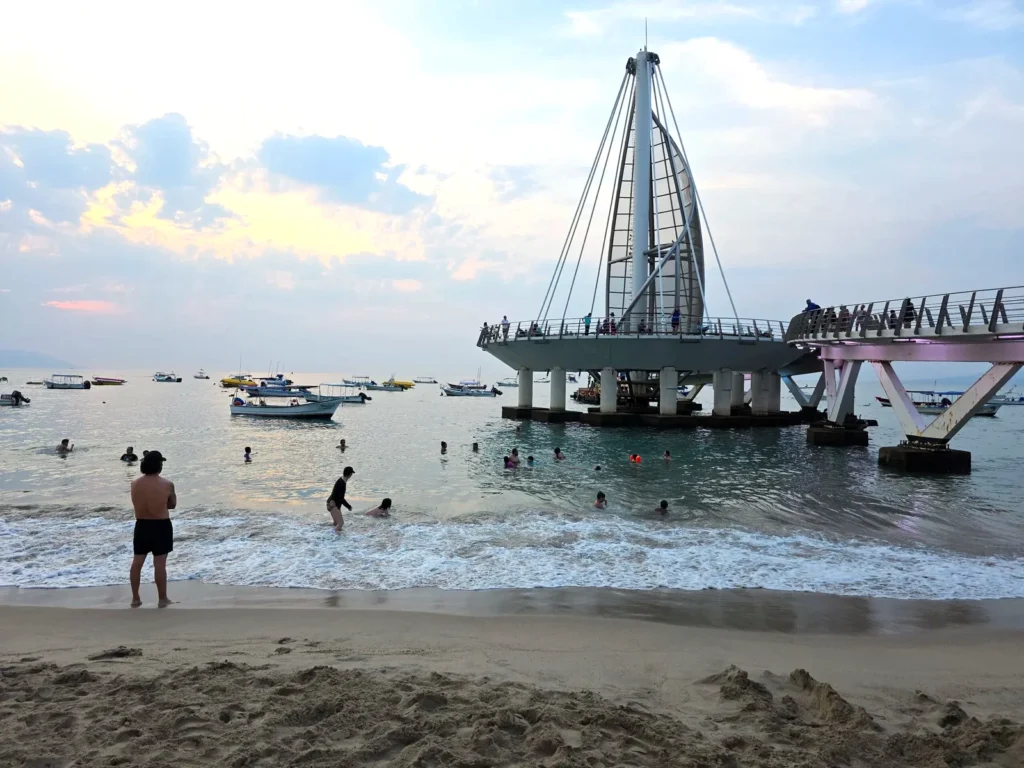
Puerto Vallarta offers a more cosmopolitan experience — a vibrant restaurant scene, a thriving arts community, and a beautiful stretch of Pacific coastline. It is more expensive than Lake Chapala, particularly for housing, but it compensates with a wider range of services, a large English-speaking population, and excellent private medical facilities.
Mérida: Colonial Elegance in the Yucatán
Mérida is the capital of the Yucatán state and one of Mexico’s safest and most livable cities. Its colonial architecture, tree-lined boulevards, and proximity to Mayan archaeological sites make it a culturally rich place to retire. The city has seen a significant influx of expats in recent years, driving investment in English-language services and international-quality healthcare.
FAQ: Your Most Pressing Questions Answered
How much money do I need to retire in Mexico from Canada?
To qualify for a Temporary Resident visa in 2026, you need to demonstrate approximately $4,300 USD in monthly income or $71,000 USD in savings (based on current UMA values). For day-to-day living, most couples find that $1,800 to $2,500 USD per month covers a comfortable lifestyle in most retiree-friendly cities — significantly less than equivalent living costs in Canada.
Can I collect my CPP, OAS, and Social Security in Mexico?
Yes. Both Canadian and American government pensions are fully portable — you can receive them anywhere in the world. For Canadians: a 15% non-resident withholding tax applies at source under the Canada-Mexico tax treaty.
You can claim this as a foreign tax credit on your Mexican tax return to avoid double taxation. It is advisable to consult a cross-border tax specialist before you move.
Is Mexico safe for retirees?
Safety varies significantly by region, just as it does in Canada or the US. The areas most popular with retirees — Lake Chapala, Puerto Vallarta, Mérida, and San Miguel de Allende — have strong safety records and well-established expat communities with decades of history. The key is choosing your city carefully and taking the same common-sense precautions you would anywhere.
Can I bring my car from Canada or the US to Mexico?
Yes, under a Temporary Import Permit (TIP), you can bring a foreign-plated vehicle into Mexico for the duration of your temporary residency. However, permanent residents are not permitted to keep a foreign-plated vehicle in Mexico long-term. Many retirees choose to sell their vehicle before making the permanent move and purchase a Mexican-registered car locally.
Do I need to speak Spanish to retire in Mexico?
You can get by with English in most expat communities, particularly in Lake Chapala, Puerto Vallarta, and San Miguel de Allende, where English is widely spoken in shops, restaurants, and medical offices. That said, learning even basic conversational Spanish will dramatically improve your day-to-day experience, help you build relationships with locals, and give you greater independence.
What happens to my OHIP or provincial health coverage when
Most Canadian provinces will cancel your provincial health insurance after you have been out of the country for a set period — typically 6 to 7 months. This is one of the most important things to plan for before you move. Ensure you have private expat health insurance in place before your provincial coverage lapses. Do not assume your travel insurance will cover long-term residency — it will not.
AI Prompts: How This Article Was Built
This article was researched and drafted using a structured AI-assisted workflow. Below are the key prompts used, which you can adapt for your own research or to ask follow-up questions to an AI assistant like ChatGPT or Perplexity.
Ask an AI: Visa Requirements
“What are the 2026 income and savings requirements for a Mexico Temporary Resident visa for a Canadian citizen? Please include the UMA-based calculation and the nearest Mexican consulate process.”
Ask an AI: Healthcare Planning
“Compare IMSS, private health insurance, and out-of-pocket healthcare options for a Canadian retiree living in Lake Chapala or Puerto Vallarta, Mexico. Include approximate 2026 costs for each option.”
Ask an AI: Tax Planning
“Explain the Canada-Mexico tax treaty as it applies to CPP and OAS payments for a Canadian retiree living in Mexico. What is the withholding tax rate and how do I avoid double taxation?”
Ask an AI: City Comparison
“Compare Lake Chapala, Puerto Vallarta, and San Miguel de Allende as retirement destinations for a Canadian couple on a budget of $2,000 USD per month. Include cost of living, healthcare access, expat community size, and climate.”
Your 7-Step Checklist for Retiring to Mexico
Step 1 — Get Your Finances in Order. Gather six months of bank statements, official pension letters (CPP, OAS, Social Security), and investment account statements.
Step 2 — Choose Your City. Research your top two or three candidate cities and, if at all possible, take a scouting trip of at least two to four weeks before committing.
Step 3 — Apply at a Mexican Consulate Before You Leave. The residency application process begins at a Mexican consulate in your home country.
Step 4 — Plan Your Healthcare Strategy. Decide whether you will enroll in IMSS, purchase private insurance, or use a combination of both.
Step 5 — Consult a Cross-Border Tax Professional. Before you move, speak with a tax professional who has experience with Canadian or American expat tax situations.
Step 6 — Complete Your Residency at a Local INM Office. Within 30 days of arriving in Mexico with your approved visa, visit your local immigration office to complete the residency process.
Step 7 — Build Your Local Life. Open a Mexican bank account, register with your country’s consulate in Mexico, find a local doctor, and connect with the expat community in your city.
Have questions about retiring in Mexico that this guide didn’t answer? Contact us or explore more articles in the MexPat Guide library. You can also browse our local merchant discounts — exclusive deals for expats and long-stay visitors across Mexico.
Deep Dive AI Prompts
Copy and paste any of these prompts into ChatGPT or Claude to explore this topic further:
- Act as a retirement financial planner specializing in Mexico. Research and explain the cost of living for retirees in popular Mexican cities in 2026, including housing, healthcare, food, and transportation. Provide practical budgeting tips for North American retirees planning to move to Mexico.
- Act as an immigration lawyer with expertise in Mexican retirement visas. Outline the step-by-step process to obtain a Temporary Resident Visa for retirees in 2026, including required documents, financial thresholds, and timelines. Include advice on maintaining visa status and transitioning to permanent residency.
- Act as a healthcare consultant familiar with medical services for expats in Mexico. Identify the best healthcare options for retirees, including public vs. private facilities, insurance plans available to expats, and how to access quality care affordably. Highlight key cities with top medical infrastructure for seniors.
- Act as a cultural integration coach for North American retirees in Mexico. Provide actionable tips on adapting to Mexican culture, language learning resources, community involvement, and navigating potential challenges. Suggest practical ways to build social connections and feel at home in Mexican retirement communities.
Deep Dive AI Prompts
Copy and paste any of these prompts into ChatGPT or Claude to explore this topic further:
- Act as a retirement financial planner specializing in expats. Explain the most tax-efficient ways for North American retirees to transfer and manage their retirement funds in Mexico, including information on currency exchange, banking options, and any relevant treaties between Mexico, the US, and Canada.
- Act as an immigration lawyer with expertise in Mexican residency visas. Research and outline the step-by-step process for obtaining temporary and permanent resident visas for retirees in Mexico in 2026, including required documentation, income thresholds, and timelines.
- Act as a healthcare consultant familiar with Mexico’s medical system for expats. Provide detailed advice on accessing quality healthcare as a retiree in Mexico, including how to use private vs. public healthcare, purchasing health insurance, and recommendations for areas with the best medical facilities.
- Act as a real estate advisor specializing in Mexican properties for retirees. Summarize the best regions in Mexico for retirement based on cost of living, safety, amenities, and expat communities, and explain the practical steps for purchasing property legally as a foreign retiree.
References & Further Reading

About the Author
Ken Gardner is the founder of Mexpat Guide. He writes practical, experience-based guides for Canadians and Americans relocating to or retiring in Mexico.