
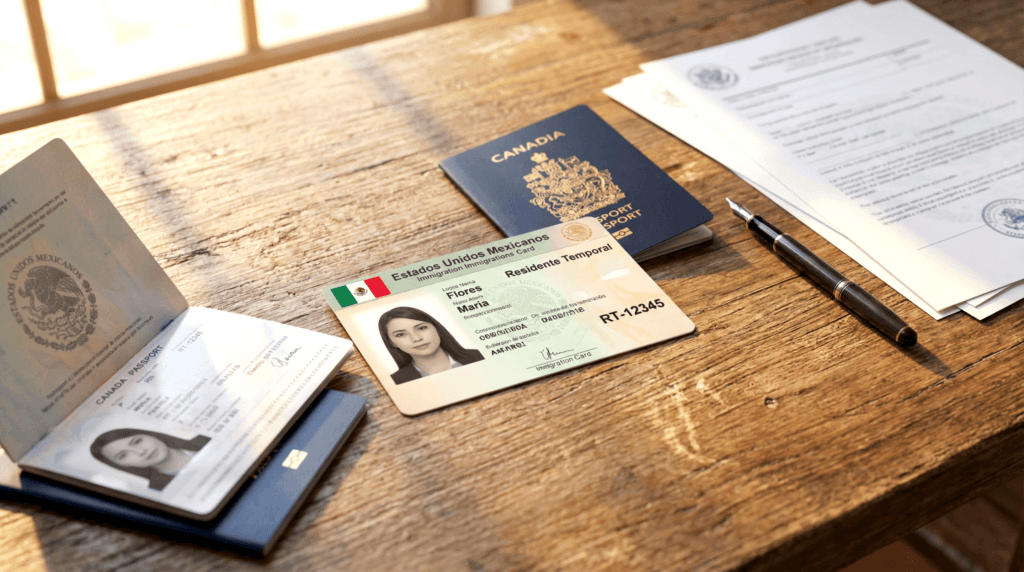
Make a working note: Prepare one residency question
Temporary and permanent residency are different legal statuses, and neither is automatically the right option for every applicant. The available route depends on the legal basis for the application, the evidence accepted by the relevant consulate or immigration office, and the applicant’s circumstances.
When planning a move to Mexico, understanding how these statuses differ is essential. While both provide a legal foundation for living in the country, they carry distinct rules regarding duration, financial solvency, work authorization, and the temporary importation of foreign-plated vehicles.
This guide explains how temporary and permanent residency differ, what factors an applicant should investigate, and why eligibility—not personal preference alone—determines the available route.
Residency Planning Snapshot
Temporal vs. Permanente in 60 Seconds
- Residente Temporal: stays over 180 days, up to 4 years. Most applications start at a Mexican consulate outside Mexico.
- Residente Permanente: indefinite stay; higher financial thresholds, and some consulates limit direct applications to retirees with pension income.
- Thresholds are consulate-specific. Example on record: the Vancouver consulate recently listed monthly tax-free income over CAD $6,461 (past 6 months) or an average balance of CAD $108,894 (past 12 months) for Temporal via economic solvency (reviewed July 2026 — not a national standard; check YOUR consulate’s current page).
- The visa is not the card. After entering Mexico, submit your canje application to INM within 30 calendar days of entry. Issuance of the resident card can take longer.
Requirements change and vary by office. Verify with the consulate where you will actually apply, and with INM. This is general information, not legal advice.
Eligibility Comes First
It is a common misconception that applicants can simply choose between temporary and permanent residency based on their long-term plans. In practice, the decision is often made by the eligibility requirements of the specific Mexican consulate where the application is submitted.
Consular offices apply the current visa rules and their published documentary requirements, and practices can differ by office. Meeting a published financial amount does not by itself establish eligibility for every residency route.
Under Mexico’s Migration Law, direct permanent-residence pathways include qualifying retirees or pensioners, family-unity categories, four years of temporary residence, having a Mexican child by birth, and certain direct-line family relationships. Confirm which legal route the consulate or INM office will process and what evidence it requires.
Key Differences at a Glance
| Topic | Temporary residency | Permanent residency |
|---|---|---|
| General duration | Time-limited, renewable up to the applicable maximum | Intended for indefinite residence |
| Renewal | Required while temporary status remains active | Resident card normally does not require periodic renewal for most adults; confirm rules that apply to the cardholder |
| Availability | Depends on the legal pathway and supporting evidence | Depends on the legal pathway and supporting evidence |
| Economic-solvency route | Requirements vary by consulate | Requirements vary by consulate and may be higher where this route is available |
| Work | Remunerated work in Mexico may require authorization | Confirm current INM notification and registration requirements |
| Foreign-plated vehicle | Residency status may affect temporary-import eligibility | Temporary-import eligibility may be restricted; verify through ANAM and Banjercito |
| Later conversion | Some temporary residents may qualify to change status | Not applicable |
| Naturalization | Separate SRE process | Separate SRE process |
This table is a planning summary, not a determination of eligibility. Immigration and customs rules depend on the applicant’s pathway and current official requirements.
Temporary Residency
Mexico’s Migration Law authorizes temporary residents to remain in the country for up to four years. The legal basis, initial documentation and renewal requirements depend on the pathway used.
Duration and Renewal
A temporary resident card is initially issued for one year. Before this card expires, the holder must apply for a renewal through the Instituto Nacional de Migración (INM) inside Mexico. The status can generally be renewed for one, two, or three additional years, up to a maximum total of four consecutive years under ordinary circumstances.
Common Eligibility Pathways
Economic solvency is one common route to temporary residence, but it is not the only route. Other possibilities include family unity and employment-based authorization. The required evidence and procedure depend on the legal basis and the authority handling the application.
Work Authorization
Temporary residents who intend to perform remunerated work in Mexico may need authorization from INM. INM’s published procedure for a current temporary resident seeking permission to work calls for a valid temporary-resident card, the applicable fee and an employment offer containing the employer’s registration information. The appropriate procedure can differ when work authorization formed part of the original immigration process.
Remote work for a foreign employer or foreign clients raises separate immigration, tax-residency and income-source questions. Do not assume that foreign payment alone resolves those questions. Obtain qualified advice for the individual circumstances. For more context on remote work, review our guide to remote work options.
Vehicle-Import Considerations
Residency status can affect eligibility for a temporary vehicle-import permit (TIP). Generally, temporary residents are permitted to temporarily import a foreign-plated vehicle into Mexico, and the TIP remains valid as long as the temporary residency status is maintained. Rules also depend on the destination, free-zone provisions, the vehicle and the permit holder. Verify the current requirements before bringing or retaining a foreign-plated vehicle.
Permanent Residency
Permanent residency authorizes a person to reside in Mexico indefinitely. Eligibility depends on the applicable legal pathway and the supporting evidence required for that route.
Indefinite Status
Unlike temporary residency, permanent residency is intended for indefinite residence. The resident card normally does not require periodic renewal for most adults. However, permanent residents must still notify INM of any changes to their address, marital status, nationality, or workplace within 90 days of the change.
Direct Eligibility Pathways
Article 54 of Mexico’s Migration Law lists permanent-residence pathways that include qualifying retirees or pensioners, family-unity categories, four years of temporary residence, having a Mexican child by birth, and certain direct-line family relationships. The procedure and documentary requirements differ by route.
Work and Notification Considerations
Article 52 of Mexico’s Migration Law authorizes permanent residents to work for remuneration. Separate tax, labour, professional-licensing and INM notification obligations may still apply.
Residents must notify INM within 90 calendar days of changes to their civil status, nationality, address or workplace.
Vehicle-Import Considerations
Mexico’s ordinary temporary-import provision for a foreign-owned vehicle applies to visitors and temporary residents. A permanent resident should not assume that a temporary vehicle-import permit can be obtained or kept in their own name.
Existing permits, vehicle ownership, authorized drivers and permit-free zones can affect the result. Verify the vehicle’s customs status with ANAM and Banjercito before changing residency status or operating the vehicle.
Moving from Temporary to Permanent
For applicants who enter Mexico as temporary residents, it is possible to transition to permanent residency later, provided they meet the criteria.
This conversion distinguishes between an ordinary change after the applicable temporary-residence period and changes based on family-unity or other pathways. Under the ordinary economic solvency route, a temporary resident who completes four consecutive years of temporary status may apply to change their condition to permanent resident.
This process takes place at an INM office in Mexico. The applicant must manage expiry and renewal issues carefully, ensuring the change of condition is filed before the final temporary card expires, while adhering to INM’s current procedural requirements.
Financial Evidence and Consulate Variation
Economic solvency is one pathway, not the only pathway, to obtaining residency. For those applying based on income or savings, it is critical to understand that consulates may differ in document periods, calculations, currencies, and evidence.
Published requirements change frequently. Applicants should use the exact current page of the consulate where they will apply. For example, the Consulate in Vancouver may require different supporting documentation or calculate the exchange rate differently than the Consulate in Leamington.
Do not rely on fixed financial figures published on blogs or social media, as these are often outdated or generalized. Always verify the exact, current requirements directly with the specific consulate handling the application.
Questions to Help Compare the Statuses
Rather than assuming one status is inherently better, applicants should evaluate their situation using these questions:
- Which legal eligibility pathway applies?
- Which status is the consulate or INM process able to issue?
- Will renewal requirements be manageable?
- Is remunerated work in Mexico planned?
- Will a foreign-plated vehicle be brought beyond permit-free areas?
- Is the move exploratory or intended to be indefinite?
- Are family-unity or other special pathways relevant?
- Is future naturalization a consideration?
- What professional immigration, customs or tax advice is needed?
Frequently Asked Questions: The Friction Points Nobody Warns You About
What if the border officer gives me a tourist stamp instead of processing my resident visa?
Check that your entry record reflects your residence-visa entry before leaving immigration. If you discover a problem later, contact INM promptly about the correction or procedure applicable to your case; do not assume an automatic cancellation or that a new border trip is the right remedy.
My bank statements are digital. Will the consulate accept printouts?
Policies vary — some consulates accept clean digital printouts, others require bank-stamped or notarized statements. Confirm the required statement format and document period with your consulate before the appointment.
Do I need an RFC (Mexican tax ID) right away?
Not automatically. You will want an RFC if you will be paid in Mexico, sell property, or need one for banking or utilities — and some banks now request it for account opening. Getting one as a resident is a SAT office procedure; tax residency is a separate question from having an ID number. Cross-border tax advice is worth its fee here.
Can I open a bank account before my resident card arrives?
Requirements differ by bank and product; do not assume either guaranteed access or a universal resident-card requirement. Ask the bank which identification, address and tax documents it accepts, and keep a backup payment method while the application is processed. Full details in our bank account guide.
Temporary vs Permanent Decision Grid
The better status depends on eligibility first, then on your timeline, age, family facts, work plans, and long-term intent.
- Temporary residency may fit people still testing Mexico or building eligibility.
- Permanent residency may fit retirees or applicants who qualify directly through the consulate.
- Consulate practices and financial evidence requirements can vary, so verify before planning around a status.
Canje and Practical Next Steps
If a person enters Mexico using a resident visa issued by a consulate, the corresponding residence-card exchange process generally must be started with INM within 30 calendar days after entry.
It is important to understand that the consular visa stamped in a passport is not the resident card. The 30-day deadline starts upon entry into Mexico. Different in-country pathways, such as family-unity and other authorized in-country procedures, may follow other procedures.
The application process requires organization and attention to detail. Use the Mexico Relocation Guide and Checklist to organize the practical steps around residency, healthcare, banking, housing and arrival. Avoiding common residency application mistakes early in the process can save significant time and expense.
Related Residency Guides
Ask MexPat Guide a residency question
Official Sources and Review Date
Prepare one residency question
Leave with one recorded question, the evidence you have and a next action. Unknown is a useful answer; a completed note does not confirm eligibility, suitability or an arrangement.
Fictional example: I have a general document list, but no confirmation of the format accepted by my chosen office. Next: request that office’s current instructions before paying for preparation.
Write and download a working note
Keep entries general. Do not enter account numbers, identification numbers, health details, phone numbers or access codes. Use private records and the recipient’s agreed channel for sensitive information.
Off by default. Without saving, entries disappear on reload. Saved notes can be seen by anyone using this browser profile. Download for use elsewhere. This note has no submission button; ordinary site analytics still apply.
Download your notes before leaving.
Clear these entries and their saved copy in this browser?
Earlier source-review context
Temporary vs Permanent Residency Verification Checklist
Before making a move based on this page, verify the details that can change by consulate, city, bank, clinic, landlord, or your personal status.
- Immigration: confirm visa and residence steps with the Mexican consulate and INM before acting.
- Taxes and finances: confirm RFC, SAT, and cross-border reporting questions with qualified professionals.
- Healthcare: verify IMSS, private insurance, and local provider details for your age, location, and health needs.
- Review note: treat this as a planning checkpoint last reviewed August 24, 2026, not a substitute for official advice.
- Ley de Migración (Migration Law) (PDF)
- INM Work Permits
- INM Resident-Change Notification Guidance
- INM Procedures
- Customs Law (Ley Aduanera) (PDF)
- ANAM Vehicle Importation
- Banjercito Temporary Importation
- SRE Naturalization
- INM Canje FAQ (2018; confirm current requirements)
Reviewed August 2026. Immigration, consular, customs, work-authorization and naturalization procedures change. Verify current requirements with the responsible Mexican authority and the specific consulate handling the application.
This article provides general educational information, not personalized immigration, legal, tax, employment or customs advice. Eligibility and the appropriate procedure depend on individual circumstances.

About the Author
Ken Gardner develops and curates MexPat Guide from Vancouver, Canada. He focuses on Mexico relocation research and practical comparison questions. This is educational planning information, not a claim of local residence or individual immigration advice.
Related Articles & Resources
Published