
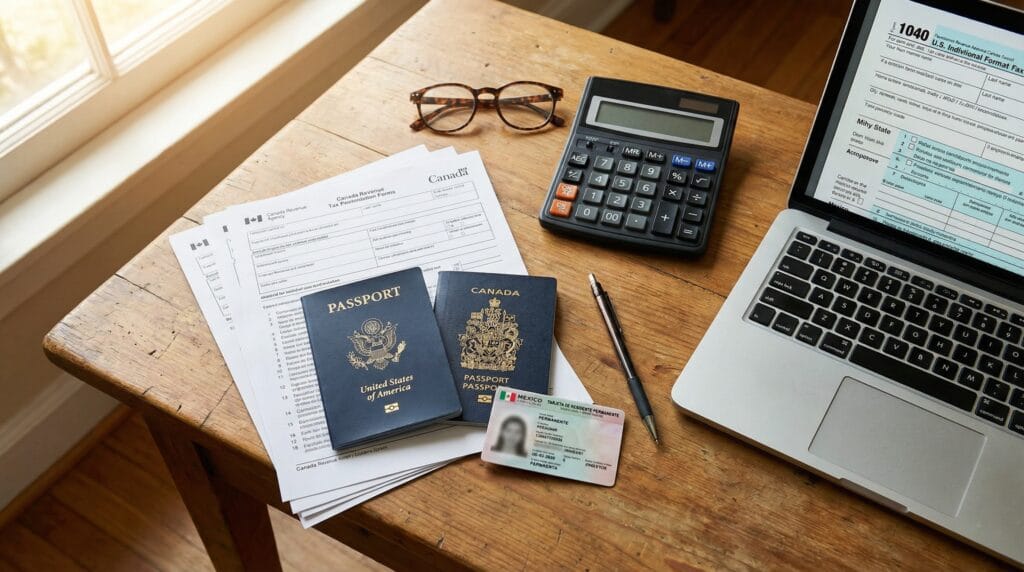
Make a working note: Prepare a cross-border tax conversation
Mexico Taxes for Expats: Start With Residency and Income Source
Tax obligations can depend on immigration status, tax residency, income source, time in Mexico, home-country rules, treaties, business activity, and personal circumstances. Use this guide as a planning overview, then confirm your situation with a qualified cross-border tax professional before making decisions.
Quick Answer: Do Expats Pay Taxes in Mexico?
Possibly. Some expats only need to keep home-country filings current, while others may have Mexican filing or reporting obligations because they become Mexican tax residents, earn Mexico-source income, rent out property, operate a business, work for a Mexican employer, or maintain financial ties in more than one country. The safest first step is to identify your likely tax residency status and income sources before you move.
- Immigration residency and tax residency are not the same thing. A temporary or permanent resident card does not automatically answer your tax-residency question. Before a consultation, prepare a dated outline of where you lived and worked, countries connected to each income source, planned move dates and questions about filings in each country. Ask the adviser which documents they need and who will coordinate any home-country advice. Use a secure channel for records; a checklist does not determine your tax status.
- Do not rely only on a simple 183-day rule. Mexico’s domestic tax-residency rules also look at where your home is and where your center of vital interests is.
- U.S. citizens and U.S. resident aliens generally still file U.S. taxes on worldwide income. Foreign tax credits, exclusions, and treaty rules may help, but they are not automatic.
- Canadians may need departure and non-resident tax planning. Residential ties, departure date, Canadian-source income, and treaty rules matter.
- Most long-term expats should speak with a cross-border tax professional. This is especially important if you have pensions, rental income, investments, business income, foreign accounts, real estate, or self-employment income.
Immigration Residency vs. Tax Residency
Your Mexico residency status helps determine how long you can stay in Mexico and what paperwork you need. Your tax residency determines where you may need to report income or pay tax. They overlap, but they are not identical.
Under Mexico’s fiscal-residency framework, an individual can be considered resident in Mexico if they have established a home in Mexico. If they also have a home in another country, Mexico may look at the person’s center of vital interests, including where more than 50% of total income is sourced or where the person’s principal professional activities are centered. Treaty tie-breaker rules may also matter in some cross-border cases.
Because these tests are fact-specific, avoid treating days in Mexico, visa type, or one checklist item as the whole answer. A qualified tax professional can help compare your Mexico facts with your home-country rules.
Check tax residence separately
Immigration status and tax residency are different questions. Do not assume a visa, tourist stay, or residence card automatically answers your tax obligations.
- Track days, income sources, work location, invoices, property, and business activity.
- Ask a cross-border tax professional before relying on forum advice.
- U.S., Canadian, and Mexican reporting can overlap even when tax treaties reduce double taxation.
When You Might Need Mexican Tax Advice
| Situation | Why it matters | What to verify |
|---|---|---|
| Retiring in Mexico on foreign pension income | Pension taxation can depend on tax residency, treaty treatment, and home-country rules. | Whether Mexico, your home country, or both may tax the income; whether treaty relief applies. |
| Remote work from Mexico | Working while physically in Mexico can raise tax, immigration, payroll, and permanent-establishment questions. | Whether your income is foreign-source or Mexico-source, whether work authorization is needed, and whether your employer has Mexican obligations. |
| Renting out property | Rental income often creates local tax, reporting, invoicing, and withholding questions. | Mexican tax regime, deductions, IVA implications, platform reporting, and home-country reporting. |
| Owning or selling property | Capital gains, notary withholding, deductions, and exemption rules can be complex. | Purchase documentation, tax basis, residency status, notary calculation, and home-country reporting. |
| Running a business or freelancing | Business activity may require RFC registration, e.firma, invoices, monthly filings, and professional setup. | SAT regime, invoicing requirements, deductible expenses, IVA, payroll, and immigration/work-permission issues. |
| Keeping investments or accounts abroad | Foreign accounts and investment income can trigger home-country reporting and possible Mexican reporting. | FBAR/FATCA for U.S. persons, Canadian non-resident rules, Mexican reporting, and treaty relief. |
What Income Could Be Taxed?
If you are a Mexican tax resident, Mexico may tax more than just income paid inside Mexico. Depending on your facts, income to review with a professional may include:
- Employment income
- Self-employment, consulting, or business income
- Rental income from Mexican or foreign property
- Investment income, dividends, interest, and capital gains
- Pensions, retirement-account distributions, and social-security-style benefits
- Income from selling property or other assets
The correct treatment can depend on the source of income, treaty rules, residence status, deductions, foreign tax credits, and whether income has already been taxed elsewhere. Your cost of living in Mexico, banking setup, and residency plans can all affect the practical side of tax planning.
U.S. Citizens and Resident Aliens Living in Mexico
U.S. citizens and U.S. resident aliens generally remain subject to U.S. tax on worldwide income even when they live abroad. That does not always mean they pay tax twice, but it usually means they need to keep U.S. filing, foreign-income, and foreign-account reporting rules on the planning list.
- Foreign tax credit: May help reduce U.S. tax when foreign income taxes are paid on the same income.
- Foreign earned income exclusion: May apply to qualifying earned income if the taxpayer has a foreign tax home and meets the bona fide residence or physical-presence test. It does not apply to every type of income.
- FBAR/FATCA reporting: U.S. persons with foreign accounts or certain foreign financial assets may have additional reporting duties.
- Treaty limitations: U.S. treaties often include saving-clause rules, so U.S. citizens should not assume a treaty eliminates U.S. filing or tax exposure.
Canadians Moving to Mexico
Canadian tax planning often starts with whether you remain a Canadian tax resident, become a non-resident of Canada, or have treaty tie-breaker issues. Residential ties, spouse or dependants, property, bank accounts, provincial coverage, Canadian-source income, and the date you settle in another country can all matter.
If you become a non-resident of Canada, there may be departure-return, deemed-disposition, withholding, and Canadian-source-income issues to review. If you keep significant Canadian ties, your analysis may be different. Review your situation before the move, not only at tax time.
Getting an RFC and Working With SAT
The RFC, or Registro Federal de Contribuyentes, is Mexico’s taxpayer registration number. You may need an RFC for tax filing, invoicing, banking, property transactions, employment, business activity, or other financial steps in Mexico.
Depending on your situation, you may also need a tax mailbox, e.firma, SAT password, local tax address, and a Mexican accountant who can help with monthly or annual filings. Requirements and appointment availability can change, so verify current SAT procedures before you rely on a checklist.
Related: opening a bank account in Mexico.
How Filing Often Works in Mexico
Taxes in Mexico are handled through SAT systems, and many expats use a Mexican accountant rather than trying to manage the portal, invoices, deductions, monthly filings, and annual declarations themselves. The right filing approach depends on whether you are registered as an employee, retiree, landlord, business owner, professional-services provider, investor, or another category.
- Confirm whether you need to register with SAT or update your RFC status.
- Confirm whether you need e.firma, a SAT password, or digital invoicing support.
- Ask whether monthly filings, annual filings, informational returns, or withholding rules apply.
- Keep records of income, deductions, rent, invoices, bank statements, residency status, and tax payments.
- Coordinate Mexican filings with U.S., Canadian, or other home-country filings.
Avoiding Double Taxation
The United States and Canada both have tax treaties with Mexico. These treaties may help allocate taxing rights, reduce withholding, or provide relief from double taxation in some cases, but treaty benefits depend on the type of income, residence status, saving clauses, tie-breaker rules, and required filings.
Do not assume that a treaty means you can stop filing in your home country or avoid Mexican filing. Use a tax professional who understands both Mexico and your home country, especially if you have pensions, rental income, investment accounts, business income, or real estate.
Questions to Ask a Cross-Border Tax Professional
For examples of how to prepare the conversation, read Fernando Camacho Limón’s interview on preparing for a first tax consultation and the GesMexa team’s six planning questions for advisers in both countries. Use these interviews to organize questions, not to determine your own tax position.
- Am I likely to be treated as a Mexican tax resident, a home-country tax resident, or both?
- Does my immigration status affect my tax obligations, or are these separate tests?
- Which income is Mexico-source, foreign-source, or treaty-sensitive?
- Do I need an RFC, e.firma, SAT password, Mexican invoices, or monthly filings?
- How are my pension, Social Security, CPP/OAS, IRA/RRSP/RRIF, brokerage, or rental income treated?
- Do I have FBAR, FATCA, Canadian foreign-reporting, or other home-country reporting obligations?
- Should I change anything before moving, such as asset sales, residency timing, account structure, or property ownership?
- How should I document travel days, income sources, tax payments, residency status, and deductions?
Common Mistakes to Avoid
- Assuming immigration residency automatically determines tax residency.
- Relying on a simple 183-day rule without checking home, center-of-interests, treaty, or home-country rules.
- Ignoring Mexico-source income, rental income, business activity, or remote-work implications.
- Not getting professional advice before selling property, renting property, starting a business, or changing tax residence.
- Forgetting home-country filing, foreign-account reporting, or foreign tax credit/exclusion rules.
- Waiting until tax season to collect documents, bank statements, invoices, and proof of residency.
Taxes in Mexico for Expats FAQ
Do I have to file taxes in both countries?
Possibly. Some people may need to file in Mexico and in their home country, while others may have only home-country filing or only limited Mexican obligations. It depends on tax residency, income source, treaties, and personal circumstances. Confirm before assuming you do or do not need to file.
Does spending 183 days in Mexico automatically make me a tax resident?
Not by itself. Day count can matter, but Mexico’s domestic tax-residency rules also consider whether you have a home in Mexico and, if you also have a home elsewhere, where your center of vital interests is located. A treaty may add another layer in some cases.
What is the RFC?
The RFC is Mexico’s taxpayer registration number. You may need it for tax filing, banking, property transactions, invoices, employment, business activity, and other financial steps. Requirements and SAT procedures can vary, so confirm current steps before booking an appointment.
Do retirees with only foreign pension income owe Mexican tax?
It depends on tax residency, treaty treatment, the type of pension, and home-country rules. Retirees should get cross-border advice before assuming foreign pension or retirement income is exempt in Mexico.
Can I use the foreign earned income exclusion if I live in Mexico?
Some U.S. taxpayers may qualify for the foreign earned income exclusion, but it generally applies only to qualifying earned income and requires meeting specific IRS tests. It does not apply automatically, and it does not replace Mexico tax advice.
Before You Move: Practical Tax Checklist
- List every income source: pensions, salary, self-employment, investments, rentals, business income, and property sales.
- Identify which country may treat you as tax resident after the move.
- Ask whether any treaty tie-breaker or double-tax relief may apply.
- Review whether you need an RFC, e.firma, SAT password, Mexican accountant, or monthly filings.
- Check home-country foreign-account, foreign-asset, and departure-reporting rules.
- Coordinate tax planning with residency, healthcare, cost of living, and banking decisions.
Planning a move to Mexico?
Use the Mexico Relocation Checklist to organize the big decisions: residency, healthcare, cost of living, housing, banking, taxes, driving, pets, and what to verify before you move.
Last reviewed: July 2026 | Scope: General Mexico tax-planning information for English-speaking expats and retirees | Status: Planning information; needs professional verification before major decisions | Important: Tax residency, filing duties, treaties, reporting forms, deadlines, and local SAT practices can change. Confirm details with SAT, your home-country tax authority, and a qualified tax professional before acting.
Tax and legal caution: This guide is general information only and is not tax, legal, accounting, immigration, insurance, or financial advice. Cross-border rules depend on your residency status, income sources, time in Mexico, home-country obligations, treaties, and personal circumstances. Consult a qualified professional before making decisions.
Related Guides
Sources and Further Reading
Prepare a cross-border tax conversation
Leave with one recorded question, the evidence you have and a next action. Unknown is a useful answer; a completed note does not confirm eligibility, suitability or an arrangement.
Fictional example: I plan to split the year between two countries. I will ask a qualified cross-border adviser which travel and income records to prepare; this note does not determine tax residence.
Write and download a working note
Keep entries general. Do not enter account numbers, identification numbers, health details, phone numbers or access codes. Use private records and the recipient’s agreed channel for sensitive information.
Off by default. Without saving, entries disappear on reload. Saved notes can be seen by anyone using this browser profile. Download for use elsewhere. This note has no submission button; ordinary site analytics still apply.
Download your notes before leaving.
Clear these entries and their saved copy in this browser?
Earlier source-review context
Taxes Verification Checklist
Before making a move based on this page, verify the details that can change by consulate, city, bank, clinic, landlord, or your personal status.
- Immigration: confirm visa and residence steps with the Mexican consulate and INM before acting.
- Taxes and finances: confirm RFC, SAT, and cross-border reporting questions with qualified professionals.
- Healthcare: verify IMSS, private insurance, and local provider details for your age, location, and health needs.
- Review note: treat this as a planning checkpoint last reviewed August 24, 2026, not a substitute for official advice.
- Cámara de Diputados — Código Fiscal de la Federación
- IRS — Publication 54: Tax Guide for U.S. Citizens and Resident Aliens Abroad
- IRS — Mexico Tax Treaty Documents
- Canada Revenue Agency — Leaving Canada / Emigrants
- Government of Canada — Canada-Mexico Income Tax Convention
- SAT — Servicio de Administración Tributaria

About the Author
Ken Gardner develops and curates MexPat Guide from Vancouver, Canada. He focuses on Mexico relocation research and practical comparison questions. This is educational planning information, not a claim of local residence or individual immigration advice.
Published