
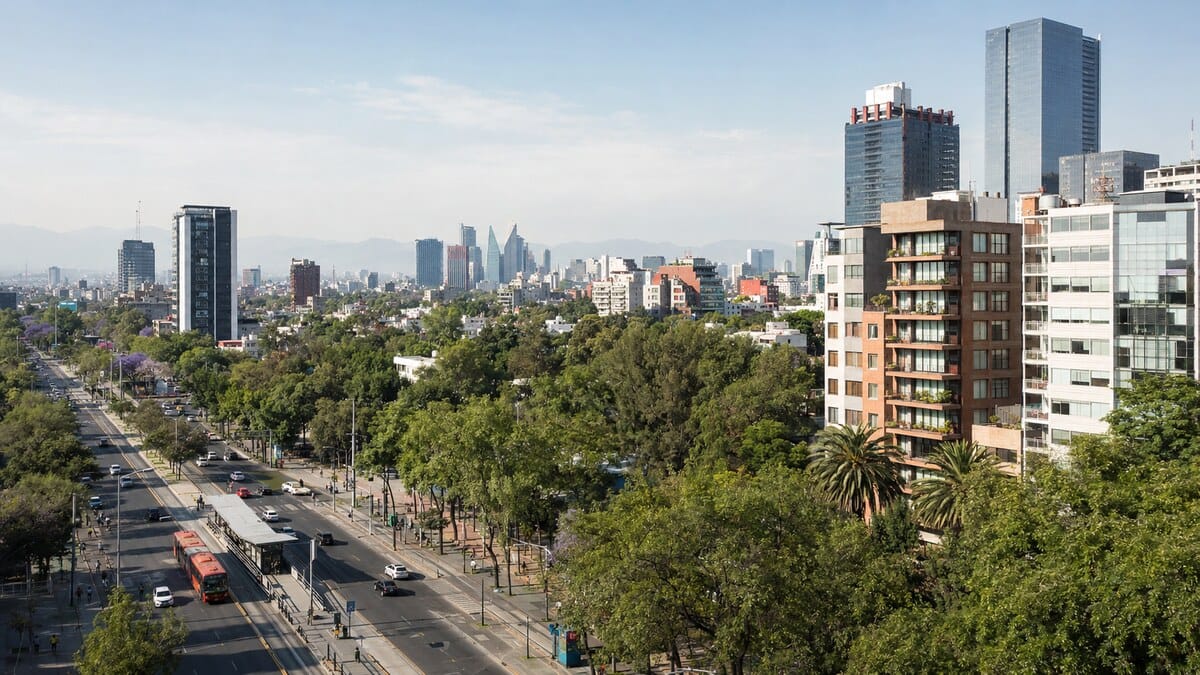
Mexico City
Cost of living, healthcare, safety and everyday life.
Is Mexico City right for you?
Local information: Explore local selections, arrival information and practical links on Mexico City Now. Check each item’s date; the dashboard is not a real-time emergency alert service. Prefer email? Preview the Mexico City briefing and choose your cities. Emails are sent when fresh, checked content is available, with no fixed sending schedule.
Reviewed July 2026
Mexico City can offer something few Mexican destinations can match: a large, complex urban life with extensive public transportation, major cultural institutions, varied neighborhoods and a wide range of everyday services. That same scale is the principal trade-off. A move that works beautifully in one part of the city can be exhausting in another because of commute time, noise, air quality, water arrangements, building condition or distance from the people and services you use most.
The useful question is therefore not simply, “Is Mexico City a good place for expats?” It is: Which part of Mexico City supports the life you actually intend to live, and what must you verify before signing a lease?
For current weather, air quality, local notices, events and service disruptions, keep this evergreen guide open alongside Mexico City Now.
Quick decision summary
| Mexico City may suit you if… | Think carefully if… |
|---|---|
| You want a highly urban lifestyle with cultural activities and everyday services close at hand. | You need quiet surroundings and are unwilling to test the building and street at several times of day. |
| You can organize daily life around a carefully chosen neighborhood, public transportation, walking and short car trips. | You require predictable short travel times across a very large city. |
| You value a broad choice of neighborhoods rather than one concentrated expat district. | You need step-free access but cannot verify the complete route, building entrance, elevator and nearby sidewalks. |
| You are prepared to use Spanish for leases, repairs, building management and official services. | You want uninterrupted water service without investigating the building’s storage and pumping arrangements. |
| You accept the planning and trade-offs that accompany major-city choice and energy. | Seismic risk, altitude, air quality, congestion or the daily complexity of a megacity would create persistent stress. |
This is not a score. It is a filter. A week that feels exciting as a visitor may not resemble the routine you would have after six months.
2026 City Fit Snapshot
Use this city guide as a fit test, not a promise that the city will match your needs in every neighborhood.
- Verify healthcare access, housing supply, internet, transportation, and safety routines in your exact neighborhood.
- Check climate, altitude, humidity, noise, and mobility during the season you would actually live there.
- Rent first when possible and test ordinary errands before making a long-term commitment.
First understand the geography
Mexico City—officially Ciudad de México and commonly abbreviated CDMX—is divided into 16 alcaldías, or borough-level territorial divisions. The official city boundary is not the same thing as the much larger metropolitan area that extends into the State of Mexico. Search results and rental listings may use “Mexico City” loosely, so confirm both the alcaldía and the exact colonia before comparing homes. The city’s open-data portal provides the official boundaries of the 16 alcaldías.
For relocation planning, it is more useful to compare daily-life patterns than to accept a universal “best neighborhoods” list:
| Living pattern | Examples to investigate | What to test in person |
|---|---|---|
| Central, dense and activity-oriented | Parts of Cuauhtémoc, Benito Juárez and Miguel Hidalgo | Night noise, building condition, crowding, grocery access and the real door-to-door commute |
| Southern, residential and culturally oriented | Parts of Coyoacán and Tlalpan | Distance to Metro or Metrobús, hill and sidewalk conditions, late-evening transport and travel to regular appointments |
| Western business and hillside areas | Parts of Álvaro Obregón and Cuajimalpa | Car dependence, steep streets, rain access, commute bottlenecks and distance from daily errands |
| More locally focused areas beyond the usual expat search | Colonias across the northern, eastern and outer alcaldías | Spanish requirements, exact transit links, local services, flood or other mapped risks and whether the area fits your routine |
These are search frameworks, not endorsements. Even adjacent colonias can feel and function differently. The official tourism office’s neighborhood histories and Mexico City guide can help you understand local identity, but a tourism description is not a substitute for a relocation visit.
Choose the commute before the apartment
A visually attractive home can be the wrong home if it creates a difficult daily journey. Before you negotiate a lease, identify the two or three trips you will make most often—perhaps to work, a hospital, a family member, a language class or a weekly activity—and test them during the hours you would actually travel.
Use the official Metro network map for route planning and check the current Metro service status before relying on a line. Then make the full trip, including:
- The walk from the building to the station or stop.
- Transfers, stairs, platforms and waiting time.
- The final walk at the destination.
- The return trip after dark or in rain, if that will be part of your routine.
- A backup route when the normal service is disrupted.
If accessibility is important, verify the entire journey rather than assuming that one elevator icon makes the route step-free. Station access, transfers, sidewalks and the destination building all matter.
Personal safety: verify the street and routine
No citywide label can tell you whether a particular home and daily routine will feel secure. Conditions can differ by colonia, street, hour and transport route. The Mexico City open-data portal publishes the Fiscalía’s investigation-file dataset, but reported investigations are not the same as a complete measure of crime or personal risk.
Use official data as one input, then test the actual routine:
- Visit in daylight and assess an evening journey only when current guidance and local conditions make it appropriate.
- Walk between the home, transit stop, grocery store and other regular destinations.
- Check lighting, building access, sightlines and how you would enter while carrying groceries or luggage.
- Ask how deliveries, visitors and tradespeople enter the building.
- Identify a backup route and a safe arrival plan for late evenings.
Canadians should also review the current Government of Canada travel advice for Mexico; Americans can consult the U.S. State Department Mexico advisory. These national advisories are useful context, not neighborhood ratings.
Housing: inspect the building, not just the apartment
In Mexico City, building-level questions can be as important as the advertised rent. Ask the landlord or administrator for clear answers, and include agreed responsibilities in the written lease.
Water
The city’s Agua en tu Colonia tool publishes water-supply information by alcaldía and colonia. Check the exact location at Agua en tu Colonia, then ask:
- Does the building have a cistern and rooftop tanks?
- How much storage is available relative to the number of apartments?
- Is water pumped automatically to upper floors?
- Who pays for a tanker delivery if one is needed?
- Has the building recently experienced low pressure or scheduled supply?
- Who maintains the pump, cistern and tanks?
The citywide tool does not answer these building-specific questions.
Structure and mapped hazards
Use the official Mexico City Risk Atlas to review available hazard, vulnerability and exposure layers for the area. It combines city and alcaldía information; it does not certify that a particular property is safe.
For a serious rental or purchase decision, ask about the building’s age, structural documentation, material repairs and post-earthquake inspections. Obtain qualified professional advice when the condition or history is unclear. Also locate the stairs, assembly point, gas shutoff and emergency exit instead of assuming you will find them during an emergency.
Living with seismic risk
Earthquake preparedness is part of ordinary life in Mexico City. Learn the building’s evacuation or shelter-in-place plan, locate lower-risk areas and participate seriously in drills. The city’s seismic warning may provide useful notice for some earthquakes, but warning time varies and not every felt event will activate the loudspeakers.
Mexico City’s Civil Protection authority publishes an official earthquake action guide. Use it to prepare before a tremor rather than improvising during one. When viewing a home, ask where residents gather, what route they use, how the building communicates after an event and who can shut off gas.
Noise, light and ventilation
Visit at morning rush hour, in the evening and on a weekend. Listen from the bedroom with the windows both open and closed. Check nearby restaurants, nightlife, schools, construction, delivery areas, rooftop equipment, aircraft routes and street vendors. Confirm whether the unit has cross-ventilation and how hot it becomes in direct sun.
Lease and operating questions
- Is the quoted rent in pesos, and how may it increase?
- Which utilities, maintenance charges and local fees are included?
- What deposit, fiador or aval, obligado solidario, legal-protection policy or other security is required?
- Who is responsible for appliances, plumbing, water pumps and internet installation?
- What type of gas serves the unit, who arranges refills or delivery, and how will drinking water be handled?
- Is short-term letting permitted in the building?
- Are pets allowed in both the lease and condominium rules?
- Is the elevator dependable, and what happens during a power interruption?
- Which internet providers can serve this exact unit, not merely the colonia?
- If you work remotely, can you test the wired connection and Wi-Fi performance inside the rooms where you will actually work?
Rental requirements vary by owner and property. Some landlords ask for a fiador or aval—often a guarantor with qualifying property—while others may accept an obligado solidario, a rental bond or a paid póliza jurídica that supports screening, contract preparation or legal protection. Do not assume these terms are interchangeable. Ask for the exact requirement, provider, cost, coverage and refundability in writing before applying.
Do not send a deposit until you have verified the owner or authorized agent, the property, the agreement and the payment instructions.
Environment and health planning
Air quality should be part of routine planning, particularly for people with respiratory or cardiovascular concerns. For current conditions, use Mexico City’s official hourly Air and Health Index, which reports air quality and associated guidance. The ProAire ZMVM 2021–2030 program is useful policy background, not a live conditions service. Mexico City Now also brings the current air reading into the local briefing.
INEGI lists Mexico City’s altitude as 2,240 metres above sea level in its 2024 geographic data. If you have a condition that may be affected by altitude or pollution, discuss the move with a qualified clinician who knows your medical history. A general destination guide cannot determine whether the environment is appropriate for you. See INEGI’s climate and altitude summary.
During the rainy season, the effect of a storm can be highly localized. The city water authority provides an official weather radar that can help with same-day planning. When evaluating a home, ask residents and building staff what happens to the street, entrance, garage and commute during heavy rain.
Healthcare in Mexico City: plan around your own needs
Mexico City has public and private healthcare providers, but “healthcare is available” is not a complete relocation plan. Build a personal care map before you move:
- Identify a routine-care provider and a hospital that accepts your intended payment or insurance arrangement.
- Confirm the location, hours, appointment process and language support directly.
- Ask your insurer which facilities are in network and whether preauthorization is required.
- Estimate travel time from the proposed home during busy periods.
- Decide how you would reach emergency care if your normal transport were unavailable.
- Bring a current medication list, diagnoses, allergies and emergency contacts.
The Mexico City health secretariat maintains an official directory of public health units, including links to health centers, hospitals and clinics. This is useful for identifying public facilities, not for inferring English availability, insurance acceptance or suitability for a particular condition. Confirm those details with the provider.
For broader planning, also read the MexPat Guide healthcare overview.
What will determine your cost of living in Mexico City?
There is no responsible single “expat budget” for Mexico City. Your actual cost is shaped by decisions that broad online estimates often hide:
- Colonia, building age and proximity to popular visitor districts.
- Furnished, semi-furnished or unfurnished housing.
- Length and terms of the lease.
- Transit-based living versus frequent taxis or car ownership.
- Public, private or international healthcare and insurance choices.
- Imported groceries, frequent dining out and paid cultural activities.
- Travel home and the exchange rate of your income.
- Building charges, water arrangements, parking and pet requirements.
Build a peso-denominated trial budget from homes and services you can actually verify. Include deposits and setup costs separately from recurring expenses, and stress-test the result against an unfavorable exchange-rate change. The MexPat Guide cost-of-living guide can provide categories, but current local quotations should drive the final number.
Transportation and airport access
Some residents can organize much of their routine around Metro, Metrobús, walking and short car trips, but feasibility is specific to the home and the journeys involved. A car can add parking, traffic, verification and maintenance constraints; car-free living can add transfers and accessibility limitations. Test both options against your own week.
If you may keep or bring a car, review the current vehicle-verification and Hoy No Circula rules. Restrictions depend on registration, verification status and current environmental rules, so verify your exact vehicle rather than relying on a general summary.
For flights, confirm which airport and terminal appear on the ticket, then check current ground transportation before departure. Operational details can change and belong in the Mexico City Now briefing, not in an evergreen relocation guide.
Accessibility and aging in place
Accessibility in Mexico City is a chain: apartment, elevator, entrance, sidewalk, crossing, transit station, transfer and destination. One weak link can make an otherwise suitable home impractical.
During a scouting stay, test:
- The route to groceries, pharmacy and routine healthcare.
- Curbs, pavement, gradients, lighting and safe places to cross.
- Building access with groceries, luggage or a mobility aid.
- Elevator dimensions and the backup plan when it is unavailable.
- The journey to a hospital at a realistic time of day.
- Home delivery and caregiver access.
- Whether daily needs remain manageable during heavy rain or poor air quality.
Choose for the life you may need in several years, not only for the mobility you have today.
A seven-day scouting plan
Before arrival
- Choose two or three areas representing different trade-offs.
- List your essential weekly journeys.
- Book ordinary accommodation rather than treating a hotel district as proof of residential fit.
- Arrange viewings only after confirming the exact address or nearest intersection.
While you are there
- Day 1 — Orientation: Make the main transit trips and locate groceries, pharmacy and an emergency-care option.
- Day 2 — First area: Inspect several buildings, not just units. Test daytime routes and assess any evening journey only when current guidance and local conditions make it appropriate.
- Day 3 — Second area: Repeat the same tests so the comparison is fair.
- Day 4 — Healthcare and administration: Confirm provider, insurance, banking and document questions in person where necessary.
- Day 5 — Weather and utilities: Check water information, risk layers, drainage, shade and building systems.
- Day 6 — Live an ordinary day: Buy groceries, do laundry, take your normal exercise and make a round trip at the time you expect to travel.
- Day 7 — Review: Score each option against your own non-negotiables. Do not sign because the visit is ending.
Questions to answer before signing a lease
- What are the exact colonia and alcaldía?
- What are my three most frequent door-to-door travel times?
- What is the building’s water storage and delivery arrangement?
- What structural records or recent inspection information are available?
- What does the Risk Atlas show for this location?
- What noise did I observe at night and on the weekend?
- What is included in rent, what security is required, and what can change during the lease?
- How will I reach routine and emergency healthcare?
- Can I manage the entrance, sidewalks, transit and apartment if my mobility changes?
- Have I verified the owner or agent and obtained an understandable written agreement?
Current Mexico City information
Prefer city selections by email? Preview the Mexico City briefing and choose your cities. Emails are sent when fresh, checked content is available, with no fixed sending schedule.
Scouting Trip Checklist
Planning local appointments? Browse healthcare contacts in Mexico City on MexPat Now. Confirm details directly; inclusion is not an endorsement.
A useful scouting trip should test daily life rather than only confirming that the destination is attractive.
- Visit clinics, pharmacies, grocery stores, banks, transit routes, and potential neighborhoods.
- Check morning, evening, weekday, and rainy-season conditions when possible.
- Ask local residents about utilities, noise, flooding, medical access, and rental expectations.
Mexico City Planning
Explore Other Mexican Destinations
- Puerto Vallarta — Retirees & Beach Lovers
- Mérida — Yucatán City Living
- Lake Chapala / Ajijic — Expat Haven
- San Miguel de Allende — Culture & Arts
- Oaxaca City — Culture & Cuisine
- Playa del Carmen — Beach & Digital Nomads
- Guanajuato — Colonial Charm
- Ensenada — Baja Coastal Living
- Mazatlán — Value & Beach
- Tulum — Wellness & Nature
- Compare everyday life in Queretaro
- Compare everyday life in Guadalajara
Editorial sources
Reviewed July 30, 2026:
- Government of Mexico City Open Data, alcaldía boundaries.
- INEGI, climate and altitude summary.
- Mexico City Tourism Secretariat, tourism guide and neighborhood histories.
- Mexico City Metro, network map and service status.
- Mexico City water authority, Agua en tu Colonia and weather radar.
- Mexico City Secretariat of Comprehensive Risk Management and Civil Protection, Risk Atlas and earthquake action guide.
- Mexico City air-quality authorities, hourly Air and Health Index and ProAire ZMVM 2021–2030.
- Mexico City Secretariat of Health, health-unit directory.
- Mexico City Open Data, FGJ investigation-file dataset.
- Government of Canada, travel advice for Mexico, and U.S. Department of State, Mexico travel advisory.
- Mexico City Environment Secretariat, vehicle verification and Hoy No Circula services.
- Inmuebles24, renting without an aval and why an aval may be requested.
Local experts and interviews
Find editorial perspectives to support your research. These are editorial conversations, not provider endorsements or independent credential checks.
We do not yet have a published interview assigned specifically to this area. For broader planning, browse countrywide interviews.
Published