
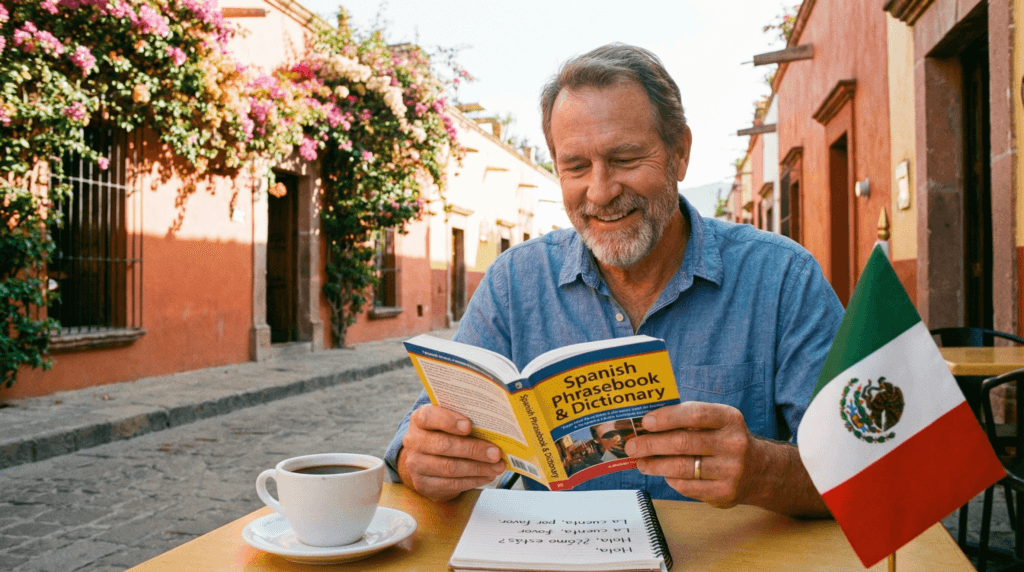
TL;DR: This guide provides a comprehensive list of “hacks” to help English speakers learn Spanish faster. By focusing on cognates, pronunciation shortcuts, grammar patterns, and essential phrases, you can quickly expand your vocabulary and confidence. This article covers everything from mastering the alphabet to avoiding common “false friend” mistakes, with a special focus on Mexican Spanish.
- Immediate Action Steps:
- Learn the Spanish alphabet to master pronunciation.
- Memorize the most common cognate patterns to instantly learn thousands of words.
- Use the verb conjugation “cheats” to start speaking in full sentences immediately.
- Practice the essential Mexican Spanish phrases in your daily interactions.
- Review the list of “false friends” to avoid common mistakes.
Learning a new language can feel like a monumental task, but it doesn’t have to be. For English speakers, Spanish is one of the most accessible languages to learn, thanks to the thousands of shared words and similar grammatical structures. This guide is designed to give you a set of powerful “hacks” that will accelerate your learning journey, helping you to speak and understand Spanish with greater confidence, particularly in Mexico.
Hack 1: Master the Alphabet for Perfect Pronunciation
One of the biggest gifts of the Spanish language is its phonetic consistency. Unlike English, where letters can have multiple sounds (think of the ‘a’ in ‘cat,’ ‘father,’ and ‘late’), in Spanish, each vowel has only one sound. By learning the five simple vowel sounds (a, e, i, o, u), you can correctly pronounce the vast majority of Spanish words. This simple step is the foundation for clear communication and will help you sound more like a native speaker from day one.
| Vowel | Sound | Example Word |
|---|---|---|
| A | “ah” | agua |
| E | “eh” | elefante |
| I | “ee” | iglesia |
| O | “oh” | ojo |
| U | “oo” | uno |
Hack 2: Unlock Thousands of Words with Cognate Patterns
Cognates are words that share a common origin and are often very similar in both English and Spanish. By learning a few simple transformation rules, you can instantly add thousands of words to your Spanish vocabulary. The following table outlines some of the most common cognate patterns.
| English Suffix | Spanish Suffix | English Example | Spanish Example |
|---|---|---|---|
| -tion | -ción | information | información |
| -sion | -sión | decision | decisión |
| -ity/-ty | -idad/-dad | university | universidad |
| -ly | -mente | rapidly | rápidamente |
| -ous | -oso/-osa | famous | famoso |
| -al | -al | animal | animal |
| -ic | -ico/-ica | public | público |
| -ary | -ario/-aria | dictionary | diccionario |
| -ent/-ant | -ente/-ante | different | diferente |
| -ive | -ivo/-iva | active | activo |
| -ist | -ista | artist | artista |
| -ism | -ismo | tourism | turismo |
| -ate (verb) | -ar (verb) | celebrate | celebrar |
| -ize (verb) | -izar (verb) | organize | organizar |
| -ify (verb) | -ificar (verb) | identify | identificar |
| -ence/-ance | -encia/-ancia | difference | diferencia |
Hack 3: Grammar Shortcuts for Gringos
Spanish grammar can seem intimidating, but there are several shortcuts that can simplify the learning process. Here are a few key hacks for some of the most common grammar hurdles.
Ser vs. Estar: The “Essence” vs. “State” Trick
The two Spanish verbs for “to be,” ser and estar, can be confusing. A simple way to remember the difference is to think of ser as referring to the essence of something (permanent qualities) and estar as referring to its state (temporary conditions). For example, “Yo soy alto” (I am tall – a permanent quality) vs. “Yo estoy cansado” (I am tired – a temporary state).
Gender Rules: The -o/-a Shortcut and Beyond
In Spanish, all nouns have a gender, either masculine or feminine. While there are exceptions, a general rule of thumb is that nouns ending in -o are masculine (el libro – the book) and nouns ending in -a are feminine (la casa – the house). Additionally, nouns ending in -ción, -sión, and -dad are almost always feminine.
Pluralization Made Easy
Making a noun plural in Spanish is simple. If the word ends in a vowel, add -s. If it ends in a consonant, add -es. For example, libro becomes libros, and ciudad becomes ciudades.
Hack 4: Verb Conjugation Cheats
Verb conjugations are often the most dreaded part of learning Spanish. However, there are ways to communicate effectively without memorizing every single tense and form. One of the most useful hacks is to use the structure “ir a + infinitive” to talk about the future. For example, instead of conjugating the verb comer (to eat) in the future tense, you can simply say “Voy a comer” (I am going to eat).
Another useful shortcut is to use “tener que + infinitive” to express “I have to do something.” For example, “Tengo que trabajar” (I have to work).
Hack 5: Essential Mexican Spanish Phrases
When you’re in Mexico, using a few local phrases will not only help you communicate better but will also show respect for the local culture. Here are a few essential Mexican Spanish phrases to get you started:
- ¿Mande?: A polite way to say “What?” or “Can you repeat that?”
- Así está bien: “That’s good like that” or “No, thank you.”
- Aquí tiene: “Here you go.”
- ¿Todo bien?: “Is everything okay?”
- ¡Claro que sí!: “Of course!”
- Igualmente: “Same to you.”
Bonus: False Friends to Avoid
False friends, or falsos amigos, are words that look similar in English and Spanish but have different meanings. Being aware of these can save you from some embarrassing situations. Here are a few of the most common false friends to watch out for:
| Spanish Word | Looks Like… | But Actually Means… |
|---|---|---|
| embarazada | embarrassed | pregnant |
| éxito | exit | success |
| sopa | soap | soup |
| ropa | rope | clothes |
| actual | actual | current |
| carpeta | carpet | folder |
FAQ about Spanish Hacks
- What is the fastest way to learn Spanish? The fastest way to learn Spanish is through a combination of immersion, consistent practice, and focusing on high-frequency vocabulary and grammar patterns, like the ones in this guide.
- How can I learn Spanish if I only speak English? Start by focusing on the similarities between the two languages, such as cognates. Use resources like language apps, online courses, and conversation exchange partners to practice regularly.
- What are some Spanish cognates? There are thousands of Spanish cognates! Some examples include información (information), universidad (university), and rápido (rapid).
- What are the basic rules of Spanish? Some of the most basic rules include the phonetic alphabet, noun gender, and the distinction between ser and estar. Mastering these fundamentals will provide a strong foundation for your learning.
Next Steps and Checklist
- [ ] Practice the Spanish alphabet and vowel sounds daily.
- [ ] Create flashcards for the most common cognate patterns.
- [ ] Write sentences using the ser vs. estar and verb conjugation hacks.
- [ ] Try to use at least one new Mexican Spanish phrase each day.
- [ ] Review the list of false friends to avoid common mistakes.
References
[1] espanol.com [2] Reddit – r/Spanish [3] Spanish Academy [4] Expat Spanish Lessons [5] Learn Craft Spanish [6] Borderless Spanish
Deep Dive AI Prompts
Use these prompts with your favorite AI assistant (like ChatGPT, Gemini, or Claude) to practice the concepts in this guide and accelerate your learning.
AI Prompt 1: Cognate Expansion Drill “Act as my Spanish language tutor. Using the cognate patterns in the article (like -tion -> -ción and -ity -> -idad), give me 10 more English words that follow these rules. Then, quiz me by giving me an English word and asking me to guess the Spanish cognate.”
AI Prompt 2: Verb Hack Conversation Practice “Create a simple, 10-line dialogue in Spanish between two friends planning their weekend. The dialogue must only use the verb hacks ‘ir a + infinitive’ and ‘tener que + infinitive’. Include the English translation for each line.”
AI Prompt 3: Mexican Spanish Scenarios “Write three short scenarios that might happen in Mexico, each one using at least two of the essential Mexican Spanish phrases from the article (like ‘¿Mande?’, ‘Así está bien’, ‘¡Claro que sí!’). The scenarios should be: 1) Ordering coffee, 2) Buying souvenirs in a market, 3) Asking for directions.”
AI Prompt 4: False Friends Story Challenge “Write a short, funny story (about 150 words) about an English-speaking tourist in Mexico who gets confused by three of the ‘false friends’ listed in the article: ’embarazada’, ‘sopa’, and ‘ropa’. The story should highlight the misunderstandings in a memorable way.”
{ “@context”: “https://schema.org”, “@type”: “FAQPage”, “mainEntity”: [ { “@type”: “Question”, “name”: “What is the fastest way to learn Spanish?”, “acceptedAnswer”: { “@type”: “Answer”, “text”: “The fastest way to learn Spanish is through a combination of immersion, consistent practice, and focusing on high-frequency vocabulary and grammar patterns, such as cognates and common suffix transformations.” } }, { “@type”: “Question”, “name”: “How can I learn Spanish if I only speak English?”, “acceptedAnswer”: { “@type”: “Answer”, “text”: “Start by focusing on the similarities between the two languages, such as cognates. Use resources like language apps, online courses, and conversation exchange partners to practice regularly.” } }, { “@type”: “Question”, “name”: “What are some Spanish cognates I can learn quickly?”, “acceptedAnswer”: { “@type”: “Answer”, “text”: “There are thousands of Spanish cognates. Words ending in -tion in English become -ción in Spanish (information = información), words ending in -ity become -idad (university = universidad), and words ending in -ous become -oso (famous = famoso).” } }, { “@type”: “Question”, “name”: “What are the most important basic rules of Spanish grammar?”, “acceptedAnswer”: { “@type”: “Answer”, “text”: “The most important basics include the phonetic vowel sounds (a, e, i, o, u are always consistent), noun gender (words ending in -o are usually masculine, -a are usually feminine), and the distinction between ser (permanent essence) and estar (temporary state).” } } ] }
Related Reading
Related: expat discount directory.
Planning Your Move to Mexico?
Join 3,000+ expats who use MexPat Guide. Get our free Mexico Relocation Checklist — visas, banking, healthcare, and where to live.

About the Author
Ken Gardner is the founder of Mexpat Guide. He writes practical, experience-based guides for Canadians and Americans relocating to or retiring in Mexico.