
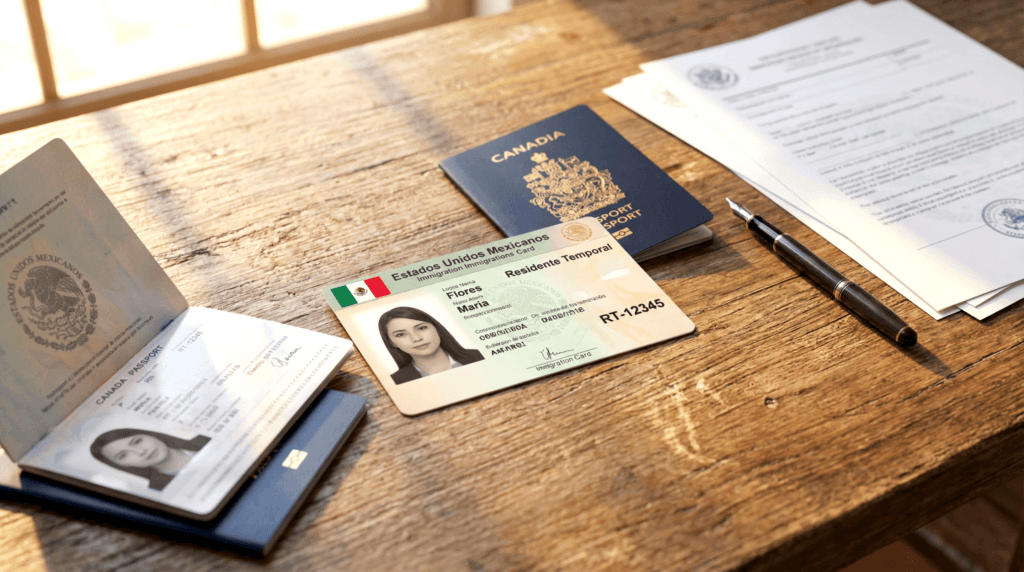
TL;DR: The main difference between Temporary and Permanent Residency in Mexico is duration and requirements. Temporary Residency lasts 1–4 years, has lower financial requirements, and is the standard path for most new expats. Permanent Residency is indefinite, has much higher financial thresholds, and is typically for those who are retired or have completed four years of temporary residency.
Understanding the Two Paths to Legal Residency
For Canadians and Americans looking to live in Mexico for more than six months, securing legal residency is a mandatory step. The Mexican immigration system offers two main long-term statuses: Residente Temporal (Temporary Resident) and Residente Permanente (Permanent Resident). Choosing the right one depends on your long-term plans, your financial situation, and your tolerance for administrative renewals.
This guide provides a clear, factual comparison to help you decide which path is the right fit for your move to Mexico.
At a Glance: Temporary vs. Permanent Residency
| Feature | Temporary Residency (Residente Temporal) | Permanent Residency (Residente Permanente) |
|---|---|---|
| Duration | 1 to 4 years | Indefinite (card never expires for adults) |
| Typical Path | Standard entry point for most new expats | Must meet high financial criteria or complete 4 years as a temporary resident |
| Renewals | Must be renewed in Mexico after Year 1, then for 1–3 more years | No renewals required for adults |
| Right to Work? | No — must apply for a separate work permit | Yes, automatically included |
| Financial Bar | Lower (more accessible) | Significantly higher |
| Where to Apply | Must begin at a Mexican consulate outside Mexico | At a consulate (if retired and financially qualified) or in Mexico after 4 years of temporary status |
The Financial Requirements for 2026
Mexico uses a formula based on the UMA (Unidad de Medida y Actualización) — a government index value updated each year — to calculate economic solvency requirements. The following figures are based on the official 2026 UMA value of $117.31 MXN.
Important Note: These are the baseline federal requirements. The specific amount and the exact documents required can vary by the Mexican consulate you apply at. Always verify with your local consulate before starting the process. Cryptocurrency statements are not accepted as proof of funds.
| Residency Type | Monthly Income (prove last 6 months) | Savings/Investments (prove last 12 months) |
|---|---|---|
| Temporary | ~$79,770 MXN (~$4,200 USD) | ~$1,344,000 MXN (~$71,000 USD) |
| Permanent | ~$133,733 MXN (~$7,100 USD) | ~$5,378,000 MXN (~$285,000 USD) |
USD conversions are approximate and will fluctuate with the exchange rate. Source: MexLaw 2026 Economic Solvency Requirements.
A Deeper Dive into Each Residency Type
Temporary Residency: The Standard Route
For the vast majority of new expats, Temporary Residency is the starting point. It is a flexible permit that allows you to live in Mexico while you settle in and decide on your long-term plans.
The Process
- Consulate Application: You must start the process at a Mexican consulate in your home country — Canada or the US. You cannot begin a residency application from inside Mexico as a tourist.
- Initial 1-Year Card: If approved, you receive a visa stamp in your passport. Upon entering Mexico, you have 30 days to exchange that visa at a local INM (Instituto Nacional de Migración) office for your first residency card, which is always valid for one year only.
- Renewals: Before your first card expires, you must renew it inside Mexico. You can renew for 1, 2, or 3 additional years, for a total of four consecutive years of temporary residency.
- Path to Permanent: After completing four consecutive years as a temporary resident, you can apply to convert your status to permanent residency — without needing to prove your finances again.
Permanent Residency: The Direct Path (for a Few)
Permanent Residency is for those who are certain they want to live in Mexico indefinitely and who meet the much higher financial requirements. The key advantage is that your residency card never expires and never needs to be renewed (for adults aged 18 and over).
Who can apply directly? If you can demonstrate the high income or savings threshold and can prove you are retired, some consulates will allow you to apply directly for permanent residency. You may also qualify if you have close family ties to a Mexican citizen or an existing permanent resident.
However, even if you meet the financial criteria, many consulates will still only grant Temporary Residency to new applicants who are not yet retired. The four-year temporary residency path remains the most reliable route for most people.
Key Considerations for Your Decision
Your long-term plans. Are you testing the waters with a part-time lifestyle, or are you 100% committed to living in Mexico permanently? If you are unsure, Temporary Residency provides a multi-year trial period with no long-term obligation.
Your financial situation. Do you comfortably meet the high bar for Permanent Residency — roughly $7,100 USD per month in income or $285,000 USD in savings? If not, the decision is straightforward: start with Temporary.
Working in Mexico. Do you plan to earn income in Mexico? Permanent Residency automatically grants you the right to work. With Temporary Residency, you must apply for a separate work permit, which adds complexity to the process.
Administrative tolerance. Are you willing to visit the INM office for annual or multi-year renewals? If you prefer a “one-and-done” administrative setup, the no-renewal nature of Permanent Residency is a significant quality-of-life advantage.
Frequently Asked Questions About Living in Mexico
Can I apply for residency while I am in Mexico as a tourist?
No. The initial application for any residency visa must be started at a Mexican consulate outside of Mexico. You cannot convert a tourist entry into a residency permit from inside the country.
If I get Temporary Residency
No. Once you have your residency card, you can enter and leave Mexico as you please. There are no minimum time-in-country requirements to maintain your residency status. However, if you later plan to apply for Mexican citizenship, you will need to prove you have been physically present in Mexico for a significant portion of the preceding years.
My spouse and I qualify financially. Do we both get
Not necessarily. When applying as a couple, the primary applicant (the one with the qualifying income or savings) may be granted Permanent Residency, but the dependent spouse is often issued Temporary Residency to start. The spouse then begins their own four-year path to permanent status.
What happens if my Temporary Resident card expires?
If you allow your card to expire, you lose your legal residency status and all the cumulative time you have accrued toward permanent residency. You cannot simply renew an expired card. You would need to either leave Mexico and start a new application from scratch at a consulate, or go through a complex and costly regularization process inside Mexico. Do not let your card expire.
Your Next Steps Toward Life in Mexico
If you are ready to begin the process, the first step is to contact the Mexican consulate nearest to your home in Canada or the US and request an appointment. Bring at least six months of bank statements and be prepared to demonstrate your financial solvency. For complex situations — particularly couples, those with mixed income sources, or those applying for Permanent Residency directly — working with a Mexican immigration attorney is strongly recommended to avoid costly delays or denials.
For a broader overview of what life in Mexico actually costs once you arrive, see our guide: The Real Cost of Living in Mexico: A Complete 2026 Budget Guide for Expats.
Deep Dive AI Prompts
Copy and paste any of these prompts into ChatGPT or Claude to explore this topic further:
- Act as an immigration lawyer specializing in Mexican residency. Explain the key differences between Temporary and Permanent Residency visas in Mexico, including eligibility criteria, application process, and associated rights and limitations. Provide practical advice on which visa type is best suited for different expat scenarios such as retirees, remote workers, and investors.
- Act as a financial advisor with expertise in cross-border living. Analyze the financial implications of obtaining Temporary versus Permanent Residency in Mexico, focusing on tax responsibilities, income requirements, and banking options. Offer actionable tips on how expats can prepare financially to meet residency requirements and optimize their financial planning while living in Mexico.
- Act as a relocation consultant for North American expats moving to Mexico. Create a step-by-step checklist for applying for both Temporary and Permanent Residency, including necessary documents, timelines, and common pitfalls to avoid. Include practical recommendations on how to streamline the process and what to expect during each stage of the residency application.
- Act as a cultural integration coach for expats in Mexico. Discuss how holding Temporary versus Permanent Residency impacts access to local services, community integration, and long-term living opportunities. Provide actionable strategies for newcomers to leverage their residency status to build a fulfilling life in Mexico, such as enrolling in healthcare, education, and social activities.
Deep Dive AI Prompts
Copy and paste any of these prompts into ChatGPT or Claude to explore this topic further:
- Act as an immigration lawyer specializing in Mexican residency. Explain the key differences between temporary and permanent residency visas in Mexico, including eligibility criteria, application processes, and typical timelines. Provide practical advice on which option suits different types of expats based on their financial situation, length of stay, and long-term goals.
- Act as a financial advisor familiar with Mexico’s expat residency requirements. Break down the income and asset thresholds required for both temporary and permanent residency permits. Offer actionable tips on how North American expats can meet these financial requirements through various income streams or savings strategies.
- Act as a relocation consultant for North Americans moving to Mexico. Outline the step-by-step process for applying for temporary and permanent residency from start to finish, including necessary documentation, common pitfalls to avoid, and estimated costs. Suggest a timeline for when to begin each application based on different relocation scenarios.
- Act as an expat who recently transitioned from temporary to permanent residency in Mexico. Share a detailed personal experience highlighting the benefits and challenges of each residency type. Provide practical recommendations for other expats considering which residency status to pursue and how to prepare for the transition.
References & Further Reading
Ready to take the next step? Contact MexPat Guide for personalised guidance on relocating to Mexico.

About the Author
Ken Gardner is the founder of Mexpat Guide. He writes practical, experience-based guides for Canadians and Americans relocating to or retiring in Mexico.