
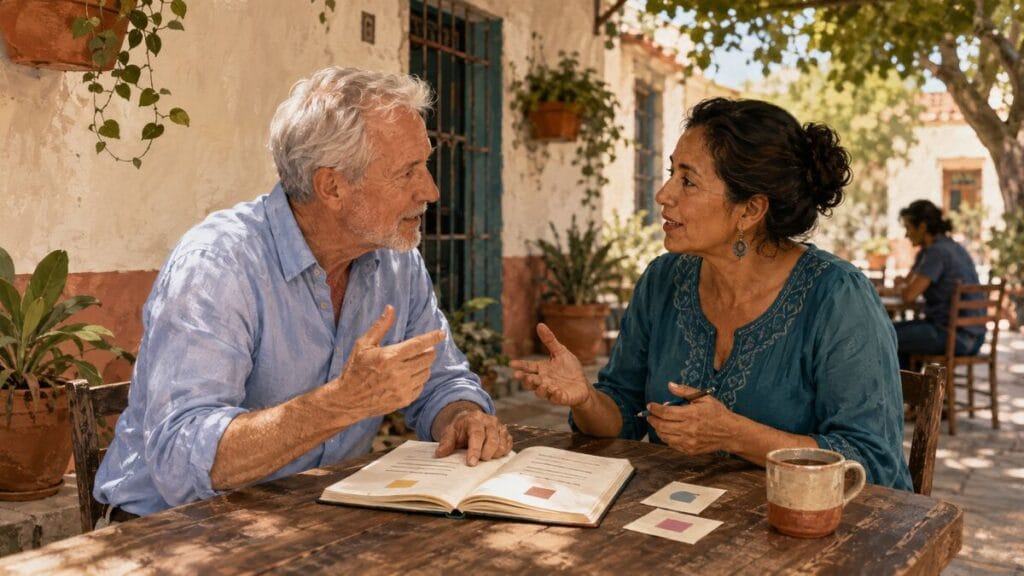
Why Spanish Helps Daily Life in Mexico
Start with one real errand, such as asking a price, confirming an appointment or explaining where you need to go. Practise both your question and the replies you might hear. Use the 30-day Spanish practice plan for a manageable routine, or phrases for when you do not understand the answer for your next conversation.

Choose practice that fits your daily life: a class or tutor for guidance, a language exchange for conversation, and short at-home sessions between them. Keep a note of the words and replies you actually needed that week.
How Much Spanish Do Expats Need?
The Spanish you need depends on the conversations your daily life requires. Whether researching Lake Chapala, Puerto Vallarta or another location, ask which language your appointment and written information will use before booking a doctor, lawyer or other service. An English-language website does not confirm that every staff member can handle your appointment in English. Practise your questions and the replies you might hear. For a starting point, read the beginner guide to familiar-looking words and pronunciation.
You do not need perfect fluency to begin. Practise explaining one everyday need and checking the answer. Confirm the language available for a specific appointment, lease or service rather than assuming every provider can work in English.
Classes, Tutors, and Language Schools
Set a practical conversation goal rather than a fluency deadline. Before paying for a class or tutor, ask about your starting level, class size, speaking and listening practice, course dates, missed lessons and a trial session. Take one real task, such as confirming an appointment, and ask how lessons will practise asking the question and understanding the reply. Compare the proposed schedule with the practice you can sustain between sessions. Options to compare include:
- Language Schools: Many popular expat destinations have dedicated language schools offering intensive group classes. These are excellent for immersing yourself in the grammar and structure of the language while meeting other newcomers.
- Private Tutors: Hiring a local tutor provides personalized instruction tailored to your specific needs and pace. Tutors can focus on the practical vocabulary you need immediately, such as terminology for opening a bank account or navigating local bureaucracy.
- Online Classes: If you want to start learning before you move, online platforms connecting you with native Mexican Spanish speakers are a great way to tune your ear to the local accent and slang.
Language Exchanges and Local Groups
An intercambio is a language exchange where people practise each other’s languages. Before attending, ask about the format, starting level, meeting point and whether you need to register. Choose a setting where you can practise one real conversation and ask for clarification; the experience depends on the group and your comfort.
Look for local Facebook groups, community bulletin boards, or expat centers that host regular intercambios. The activities sections of Mérida Now and Ajijic Now offer additional leads. Check the listed date, language level and registration requirements with the organizer; a listing is not a guarantee of a place. Try an exchange as listening and speaking practice, then decide whether its format and journey fit a routine you can repeat. Attending does not guarantee friendships or fluency.
Apps and At-Home Practice
While apps alone are rarely enough to achieve conversational fluency, they are excellent tools for building vocabulary and maintaining daily practice habits. Apps like Duolingo, Babbel, or Memrise are great for 15-minute daily sessions. To supplement app learning, try changing the language settings on your phone or watching Mexican television shows and movies with Spanish subtitles. Listening to local radio or podcasts can also help you get accustomed to the speed and rhythm of spoken Mexican Spanish.
Want a manageable first practice task? Start with our Spanish alphabet, word similarities and pronunciation tricks. It includes letter names, familiar word patterns and a short practice exercise.
Everyday Phrases for Markets, Banks, Doctors, and Neighbours
Focusing on practical, high-frequency phrases will give you the most immediate return on your learning investment. Here are a few areas to prioritize:
- Greetings: Politeness is paramount in Mexican culture. Always use Buenos días (Good morning), Buenas tardes (Good afternoon), or Buenas noches (Good evening) when entering a shop or passing neighbours.
- Shopping: Learn how to ask ¿Cuánto cuesta? (How much does it cost?) and numbers up to 1,000 for navigating local markets.
- Directions: Phrases like A la derecha (To the right), A la izquierda (To the left), and Derecho (Straight ahead) are vital for taxis and walking.
- Healthcare: Knowing how to explain basic symptoms or ask for an appointment (Quisiera hacer una cita) is crucial when navigating healthcare in Mexico.
- Administration: When dealing with your residency paperwork, knowing terms like firma (signature), copia (copy), and trámite (process/procedure) will reduce confusion.
How Spanish Supports Social Life and Local Trust
Speaking some Spanish, even imperfectly, can make everyday exchanges easier. Start with respectful questions, listen to replies and return to activities you genuinely enjoy. Repeated contact can help relationships develop; do not expect a neighbour or shopkeeper to act as your tutor or assume that language ability establishes a support network.
A Realistic 30-Day Starting Plan
For a local teaching perspective, read the Puerto Vallarta interview on practising one everyday Spanish task at a time.
If you are feeling overwhelmed, start with a manageable 30-day plan:
- Week 1: Focus entirely on polite greetings, please (por favor), and thank you (gracias). Use them with everyone you meet.
- Week 2: Learn numbers 1 through 100 and practice asking for prices at the local market or tienda.
- Week 3: Memorize 10 essential verbs (e.g., to want, to need, to go, to have) and practice combining them with basic nouns.
- Week 4: Attend one local language exchange or schedule a trial lesson with a tutor to practice speaking out loud.
Spanish First-30-Days Plan
The goal is not fluency before arrival; it is enough practical Spanish to reduce friction and show respect in daily life.
- Practice greetings, addresses, numbers, appointments, pharmacy phrases, and polite repair requests.
- Use one real errand per day as language practice.
- Keep a note of phrases you actually needed that week.
When You Do Not Understand the Answer
Practise the second half of a conversation, not only your opening question. A successful errand can mean checking an answer accurately rather than speaking quickly.
- Slow down: ¿Puede hablar más despacio, por favor? (Can you speak more slowly, please?)
- Get it in writing: ¿Puede escribirlo, por favor? (Can you write it down, please?)
- Check the total: ¿Ese es el precio total? (Is that the total price?)
- Check your understanding: Entonces, ¿la cita es el martes a las diez? (So, is the appointment Tuesday at ten?)
Take one example to a tutor and rehearse different replies. For consequential contracts or medical decisions, arrange competent language support rather than relying on memorized phrases. Add language preparation to your relocation checklist, and use the destination worksheet to note where you still need language support.
Spanish Practice Planning

About the Author
Ken Gardner develops and curates MexPat Guide from Vancouver, Canada. He focuses on Mexico relocation research and practical comparison questions. This is educational planning information, not a claim of local residence or individual immigration advice.
Published